

Understanding Proximity Sensors in Model Railroading
Proximity
Let’s talk about the typical types of proximity sensors used in model railroading. You may want to trigger a gate crossing or detect a train in a tunnel, block signaling or use computer control. One type that is used is to detect changes in light levels produced by a source of light. They can be “make” or “break” beam. Also there are current sensors and PIR Passive Infrared. Each has a place in your railroad and any can be combined with any KandR Electronics modules with any Arduino and Adafruit parts. Let’s start with the most common, the standard IR light sensors.
First you need to consider the application. Is it for sensing a train in a tunnel? Is it for Block management on a DCC system? Dead rail system? Computer signaling? Is it for sensing in a high ambient lighting situation? When a sensor is chosen correctly you will get acceptionaly good results.
Ken Glaza
IR Sensors
Standard IR Cross Track Sensors
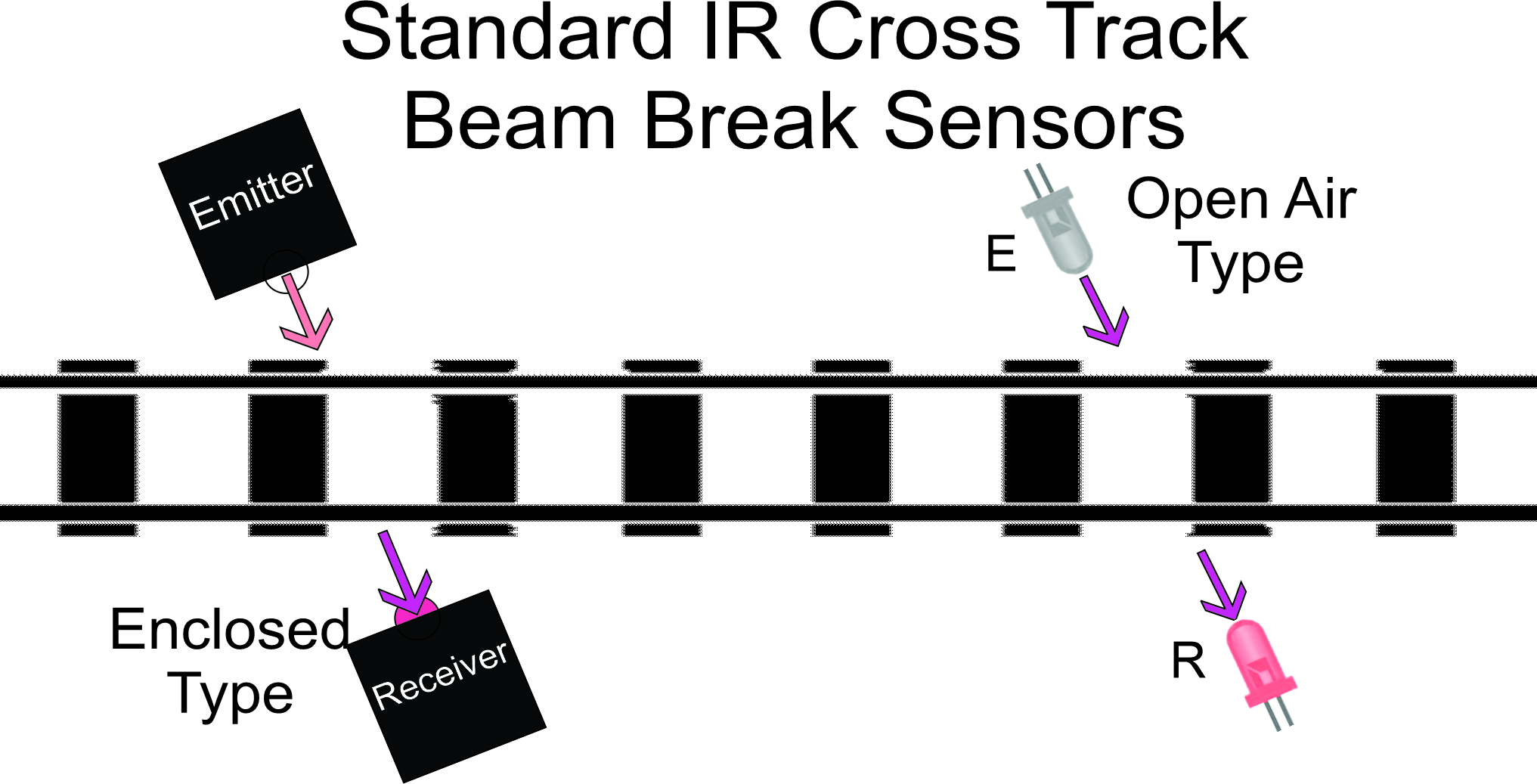
Our enclosed type (SKU-25340007) are much like the Arduino breaker beam but higher power and the open air type (SKU-25340005) are just the much smaller versions of diodes only. The receiver on our open air sensor have electronics further along the diode wires where a third wire becomes the signal wire (usually white or yellow). (SKU-25340016) It eliminates the bulky package associated with the typical IR receiver making them easier to conceal.
Placement of Beam Break IR sensors should be as close together as possible and pointed directly at one another crossing the track at an angle raised high enough such that a flat car blocks the light. Crossing multiple tracks reduces the effectiveness due to the inherent short range of IR diode pairs. Also ambient light and its’ color temperature will reduce the range of this type of sensor. These sensor parts can be concealed in utility cabinets, various vegetation’s or buildings that are typical track side structures. This type is for only one point sensing where the light crosses the track.
Laser IR Large Area Sensors
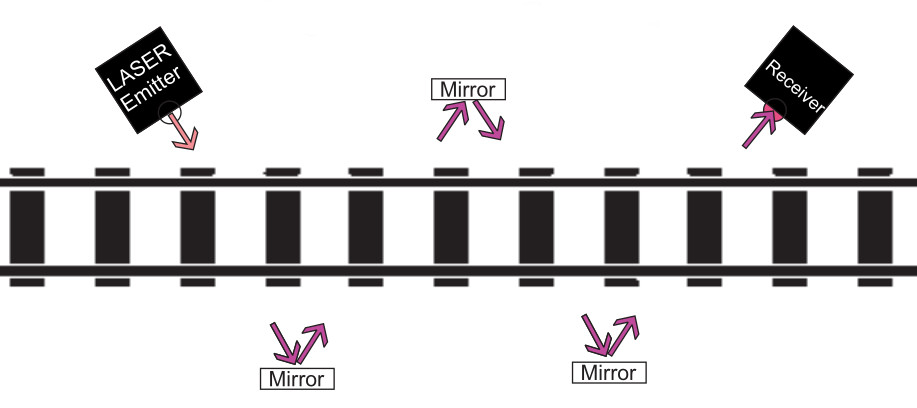
In higher ambient light situations the IR Laser emitter and sensor pair should be used (SKU-25340013). A laser will focus light into a concentrated beam that can cover large distances and larger areas crossing tracks at multiple places. This gives a much larger area of protection like both approaches and the crossing gates areas combined. First reflect type mirrors are needed so the beam is not split in the glass. Our lasers are safe low power but can reach 15+ feet or more. FYI: Our Gate kits include 2 mirrors and a Laser with Receiver. (N SKU15250011, HO SKU15250009, O SKU 15250006)
Aiming of the IR laser beam is a bit tricky. Your cell phone camera will show the beam reflected on white paper. Starting at the source move the reflective paper away from the source while adjusting the focus and direction until you hit your target. All of our gate and intersection modules (SKU-57660001) feature an alignment function for fine tuning any sensor pair but particularly useful for fine tuning dead nuts on. No one has this function in their controller. It will help in alignment of any sensor we make and is particularly useful in laser alignments.
Reflection IR Sensors
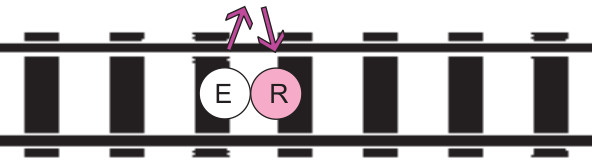
Reflector Beam Make sensors (SKU-25340024) are usually placed between the tracks to reflect on the underside of a passing train but are susceptible to a high level of overhead ambient light. Sometimes they are placed on the side of the track to reflect on the sides of rolling stock. So lower room light is best. These type sensors are best using them in tunnels or under bridges. Adding reflective foil to the under body of your rolling stock raises the trigger threshold and will help reflect the IR beam back to the receiver diode. These are only for a point in place sensing. You will need many to cover a lorge area.
Ambient Light Sensors

A fourth type of sensor are ambient light sensors (SKU-25340023). They do not need a special source IR diode or laser emitter, but could be used with one. They mostly rely on having the room light blocked by a passing train to sense train present. These sensors are great for rooms with bright ambient light or for outside garden railroads. However night session might be problematic. These are good for a point in place sensing.
PIR Passive Infrared
The PIR Passive Infrared Sensor (SKU-25340018), is a device that detects movement by sensing changes in infrared (heat) radiation from objects like people or animals in its’ field of view. Great for observer triggered events like oil well, windmill, building lights, station announcements, etc. When you approach an area, the PIR sensor will trigger an event. This is similar to the outside security lights on your home. It can be used for train detection however trailing cars may not have the same heat as the locomotive.
Current Sensors
There are two types of current sensors, an AC and a DC. An AC current sensor uses a coil. When AC current is sent through the center of the coil it produces a voltage that is compared to a reference voltage and actuates a relay or a signal wire. DC current sensors use a resistive element and measure the voltage drop across it comparing it to a reference voltage.
Current Sensors For DCC
Current sensor (SKU-25340002) are AC current sensors that work with DCC systems because DCC provides a constant AC signal of 14 volts to the rails. These are great for block signals and can cover a larger protected area specially in curved track application. Current flows when a DCC equipped engine moving or not or lighted cars set on the track drawing power in that block. To sense current feeding a track block, one wire of the power feed of the track block is looped through the sensor module coil. Current sensors have no ambient light issues, works over long rail blocks, above table eye soars are gone and they are most reliable. Most often current sensors are used for block signaling systems and crossing gate triggers.
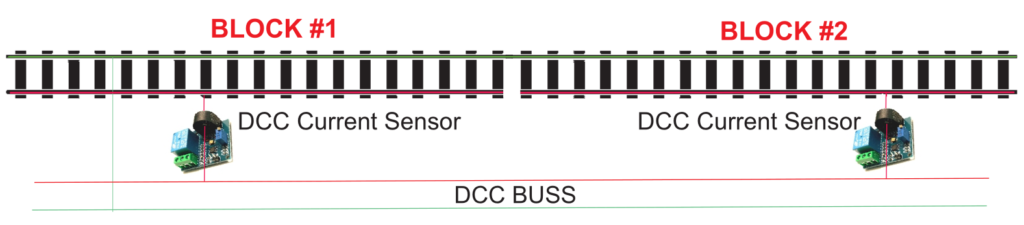
I use this method more often than any other.
Ken Glaza
DC Current Sensors
DC current sensors are a resistive type. They measure the voltage drop across a piece of wire that is feeding a track. If you are running a DC rail system this could be used to sense a train present when it is on a rail only if it is drawwing current. Not practical for a stationary train.
These are not used often enough for me to go into details.
Ken Glaza